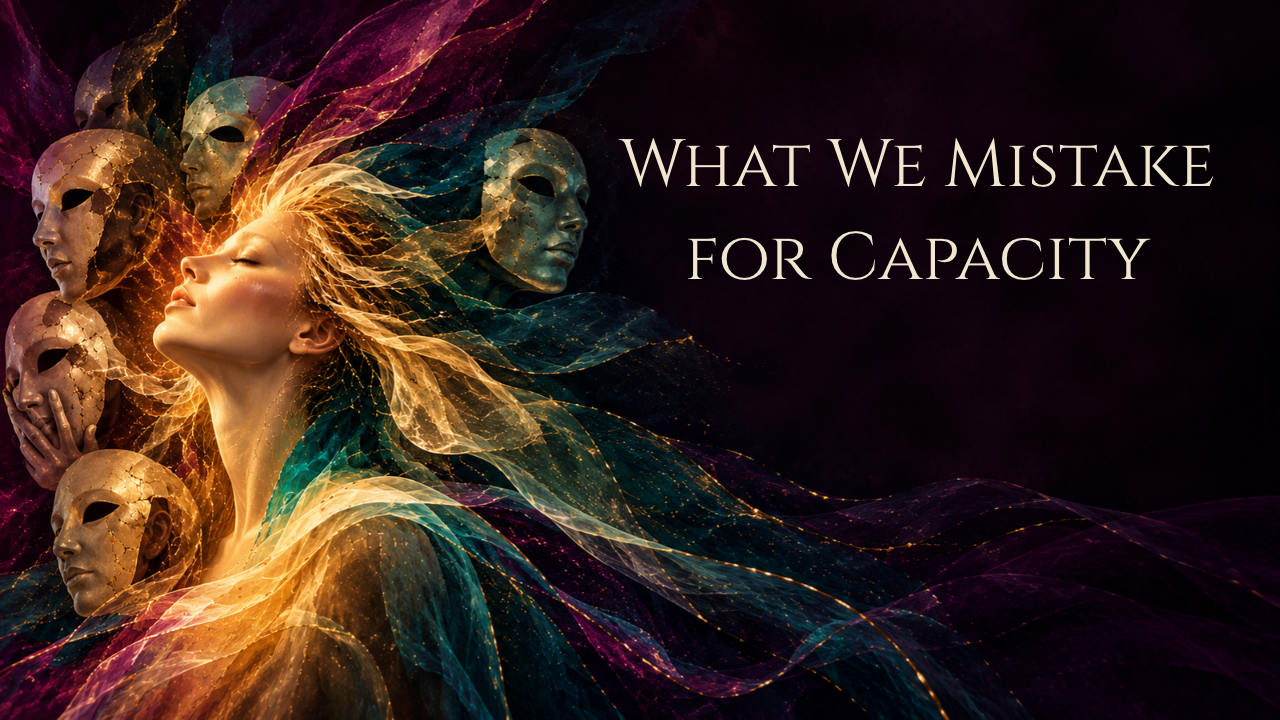
What We Mistake for Capacity: When Survival Looks Like Strength
There's something fascinating about the things we admire in people.
The person who never gives up. The one who stays in control when everything falls apart. The one who always says yes, never complains, and somehow manages to keep everyone happy.
We call them strong. Resilient. Dependable. Capable.
But I've been wondering lately whether we're sometimes celebrating the wrong things.
Because being exceptionally good at getting through life isn't necessarily the same as having the capacity to experience it.
And some of the behaviours we proudly identify as strengths may actually be survival patterns we've become very good at repeating.
The Six Disguises of Capacity
Endurance. You've learned to tolerate discomfort, disappointment, and exhaustion. You can keep going long after other people would have stopped. But endurance only tells us what you're capable of surviving. It doesn't tell us what surviving is costing you.
Control. You anticipate problems, manage details, and try to stay three steps ahead of everything. People admire how organized you are. What they may not see is how uncomfortable uncertainty feels when you can't control the outcome.
Performing. You're the person who has it together. You smile, deliver, achieve, and reassure everyone that things are fine. And sometimes they are. But sometimes the performance becomes so convincing that even you stop asking how you're actually doing.
Numbing. You don't let things get to you. Or at least that's what you tell yourself. You stay busy, distract yourself, intellectualize your feelings, or move quickly past anything uncomfortable. But not feeling something isn't necessarily the same as having processed it.
Pushing. You're proud of your ability to dig deeper, work harder, and find another gear. And there are certainly moments when that serves you. The question is whether pushing has become your only strategy, even when what you really need is permission to stop.
Pleasing. You're thoughtful, accommodating, and incredibly good at anticipating what others need. But if keeping everyone comfortable consistently requires you to abandon your own needs, the price of being liked may be higher than you realize.
None of these behaviours makes you weak.
In fact, many developed because they helped you navigate difficult circumstances.
The problem begins when a strategy that once protected you becomes the only way you know how to live.
When Being Capable Becomes a Trap
I think this is particularly relevant for people who have spent much of their lives being the strong ones.
When everyone knows you can handle things, they tend to give you more to handle.
And when you've built your identity around being capable, it's remarkably easy to confuse being needed with being valued.
So you keep going.
You accommodate.
You manage.
You hold everything together.
And because you're still functioning, you assume you're doing fine.
But functioning isn't the whole story.
You can be productive and profoundly depleted.
You can be surrounded by people and feel completely disconnected from yourself.
You can look successful while privately wondering why everything feels so damn hard.
Just because you've learned to survive something doesn't mean you've expanded your capacity to live with it.
Sometimes you've simply become more skilled at overriding your own signals.
The Difference Is Choice
Here's what I find most interesting about genuine emotional capacity.
It doesn't necessarily mean you stop being persistent, organized, ambitious, or generous.
Those qualities can be wonderful.
The difference is that you become more conscious of when and why you're using them.
You can persevere without automatically sacrificing your well-being.
You can plan without needing to control every outcome.
You can achieve without performing an identity.
You can experience uncomfortable emotions without needing to escape them.
You can challenge yourself without treating exhaustion as a badge of honour.
And you can care deeply about others without disappearing in the process.
Capacity gives you access to your strengths without requiring you to become a prisoner of them.
That's a very different kind of personal growth.
A Question Worth Asking Yourself
Think about the quality people compliment you on most often.
Your strength? Your reliability? Your work ethic? Your ability to stay calm? Your willingness to help?
Now consider something a little less comfortable.
Does that quality genuinely support the life you want, or have you become afraid of what might happen if you stopped demonstrating it?
There's no right answer.
But there may be an important realization waiting inside the question.
Because perhaps the next stage of your growth isn't about becoming tougher, more disciplined, or better at holding everything together.
Perhaps it's about recognizing where you've been confusing survival with capacity.
And discovering that you no longer have to earn your place in the world by proving how much you can endure.
You can be strong without always being the strong one.
You can be capable without always being available.
And you can build an extraordinary life without sacrificing yourself to maintain it.
That's the kind of capacity I'm interested in exploring.
Not how much more we can withstand.
But how much more fully we can live.
Mahara Wayman | The Capacity Lab
Exploring what becomes possible when we stop simply managing life and start developing the capacity to experience it.
Author